
“I think there is a light in cloudy Calcutta that only belongs to Calcutta,” says novelist and photographer Ananth Padmanabhan.
For Ananth this is perhaps the most enduring image of Kolkata: a particular quality of light falling over its streets, catching the yellow of a taxi, illuminating a crumbling facade or briefly animating the ordinary theatre of a traffic signal. It is a light he has returned to for nearly three decades, trying to hold on to a city that, in his photographs, is at once beautiful, weathered, restless and alive.
His relationship with Calcutta began in January 1998, when he travelled from Delhi to attend the city’s book fair, then held on the Maidan. Having grown up in Madras, his idea of Calcutta had been shaped largely by books and films. The city that greeted him was something else altogether.
A taxi against the backdrop of Kolkata’s Howrah Bridge
| Photo Credit:
Special Arrangement
His first solo exhibition, Calcutta: Walking in the City, was presented at the India Habitat Centre in 2012. No Refusal, his latest exhibition at the Visual Arts Gallery, India Habitat Centre, New Delhi, continues that visual conversation. The photographs, made over several years, trace the relationship between the city and a vehicle that has become inseparable from its identity.
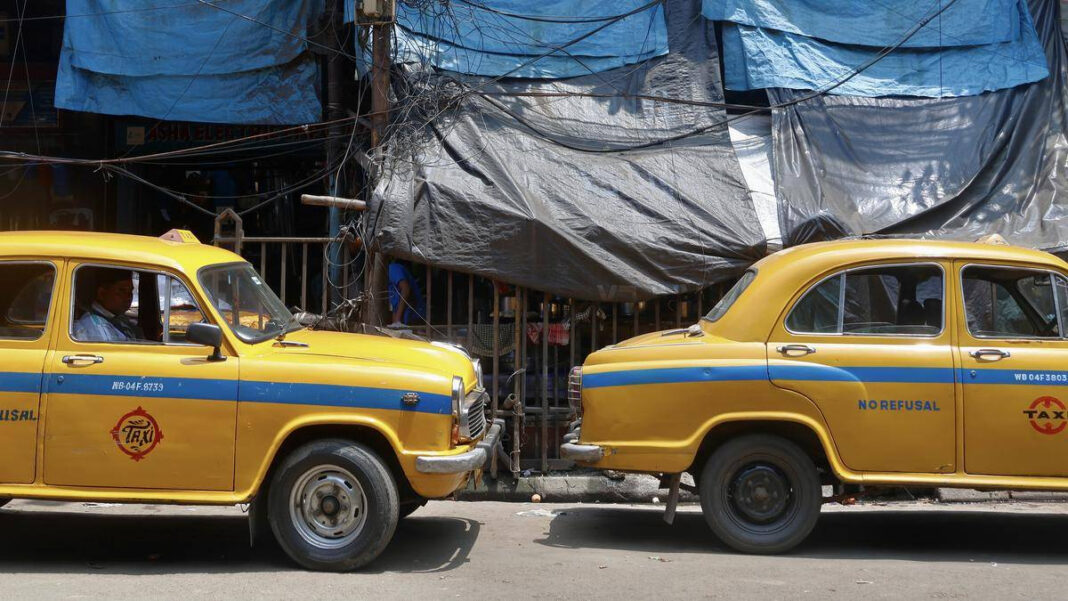
Stepping out of Howrah station, he encountered a long line of yellow Ambassador taxis. He was instantly captivated. “You stand at any traffic light in Calcutta, and there are a million images and a million stories happening simultaneously. You can’t say that about many other cities in the country,” says Ananth
Ananth began carrying his camera whenever he visited. The city offered an inexhaustible frame: its historical architecture, peeling walls, vivid colours, crowded streets and the curious vitality of its public spaces. But it was the Ambassador taxi, with its distinctive yellow body and blue stripe, that gradually became an obsession.
A city, seen through its taxis
Based on the Morris Oxford, the Ambassador had once been among the few coveted private cars available to Indian families, often after long waiting periods. Over time, it became an indispensable part of the country’s public transport landscape. In Calcutta, its yellow incarnation acquired an identity of its own.
The words No Refusal, painted across the taxi, fascinated Ananth as much as the car itself. Introduced as part of a Government directive to ensure that passengers would not be denied a ride, the phrase became an unexpected element of the city’s visual vocabulary.
Ananth Padmanabhan
| Photo Credit:
Special Arrangement
“The Government could have put that instruction anywhere. Instead, they put it across the car, in blue, against that particular yellow. It became part of the design language of the taxi itself,” he says.
For a photographer who was not Bengali but had grown emotionally attached to the city, this was a story worth preserving. The taxi was no longer merely a means of getting from one place to another. It had become a recognisable emblem of Calcutta, carrying its particular rhythms through the streets.
The human history of a machine
The urgency behind the exhibition became apparent during a visit to Calcutta in January 2026 for the book fair and literature festival. Ananth found it increasingly difficult to flag down a yellow taxi. Conversations with drivers suggested that their numbers were dwindling, with some predicting that the cars could disappear from the streets within a couple of years.
The Ambassador had stopped being manufactured in 2014-15. With no further upgrades to its engines or emissions technology, the ageing fleet has faced growing regulatory and practical challenges. But for the drivers, replacing these cars is not as simple as exchanging one vehicle for another.
A yellow taxi parked in a Kolkata neighbourhood
| Photo Credit:
Special Arrangement
Ananth says, “These cars have taken people to weddings, to funerals, through grief, to Howrah station and to the airport. They are moving receptacles of history.”
Many drivers have spent years behind the wheel of the same car, which is not merely an asset but a source of pride and livelihood. To be told that it must be scrapped and replaced, even with the promise of easier loans or a newer vehicle, is to lose something that cannot be measured in monetary terms.
One photograph in the exhibition captures this uneasy passage particularly well. At a garage in New Alipore, where old Ambassadors are scrapped, Ananth noticed a mechanic changing a tyre on a car propped up on a jack. A man walked past, climbed into the boot of the car and casually lit a cigarette while the repair continued.
The said man seated in the boot of the ambassador
| Photo Credit:
Special Arrangement
It was an unremarkable moment to everyone present. To the photographer, it was extraordinary. The car had become so much a part of the man’s everyday environment that he treated it almost like a familiar piece of furniture.
For Ananth, the image speaks to the intimacy between people and machines, a relationship that often goes unnoticed until it is about to disappear.
Modernity need not mean erasure
Ananth’s concern extends beyond the fate of the taxis. He believes Indian cities need to think more carefully about what makes them distinctive. Their identity is not held only in monuments, rivers, bridges or historic buildings. It also resides in objects, public transport, everyday rituals and the visual details that generations grow up recognising.
“If you show someone a yellow taxi, most people will immediately know it is from Calcutta,” he says.
He would like to see 500 Ambassadors retained and declared classic cars, with their engines modernised to meet environmental standards. They could continue to serve the city, perhaps ferrying visitors through historic neighbourhoods and becoming as recognisable a part of its identity as London’s black cabs or red telephone boxes.
The yellow taxi is a part of Kolkata’s identity.
| Photo Credit:
Special Arrangement
He argues, “Modernisation doesn’t mean replacement. You are enhancing the experience of history. There is nothing wrong with becoming modern, but that doesn’t mean you kick history, memory or culture out.”
He points to the Howrah Bridge, the flower market and the ferries crossing the river as experiences that could be thoughtfully preserved and improved rather than displaced. A walk across the bridge, he believes, should be on every visitor’s bucket list. Cities such as London, Paris and Barcelona have found ways to accommodate the new without entirely surrendering the old. Indian cities, he feels, must learn to strike that balance.
Even the name Calcutta, rather than Kolkata, remains a matter of personal attachment for him. Having first encountered the city under its older name, he continues to use it, much as one holds on to a familiar name for a place that has become part of one’s emotional geography.
For younger visitors, particularly those who may never have depended on an Ambassador taxi, he hopes the photographs will reveal more than a vintage automobile. They will see its design, colour and changing presence across two decades, but also recognise that it belongs to their own family histories and the collective memory of the city.
And so when the light filters through cloudy Calcutta, someone somewhere will call out, ”taxi!” and perhaps a yellow Ambassador wont answer but memories and enduring images will.
The show is on at Visual Arts Gallery, India Habitat Centre, New Delhi, till November 10.