

Jibanananda Das, often regarded as the Charles Baudelaire of Bengali Surrealist poetry, captures in his poem Banalata Sen the journey of a traveller wandering through centuries and civilisations, across seas and the dark corridors of history, carrying the solitude of a world grown impossibly vast. Then, in a moment that seems to suspend time, he encounters Banalata Sen of Natore — her face offering stillness after the day’s long drift. The poem’s enduring tenderness lies in this fleeting reprieve: the possibility of finding, amid the tumult of history, a place to rest, a presence that makes the wandering worthwhile.
Alipore Museum, formerly Alipore jail, now converted into a museum is one of the venues for the Biennale
| Photo Credit:
Special Arrangement
It is this poem that lends its name to the second edition of the Bengal Biennale, which runs from November 25, 2026, to January 2, 2027, in Shantiniketan, with its Kolkata edition opening on November 28. Organised by the Gameplan Foundation, founded by Jeet Banerjee and Malavika Banerjee, the event will unfold across multiple venues in Kolkata and Santiniketan, bringing together established cultural institutions, historic sites, artist-led spaces and alternative locations.
Venues across Kolkata and Shantiniketan
Shantiniketan: Nandan Art Museum & Gallery (Kala Bhavan), Tokaroun, Santiniketan Society of Visual Art & Design (SSVAD), Arthshila, Sculpture Park, Somnath Hore Studio and Krittika Arts Space
Kolkata: The Alipore Museum, The Indian Museum, TRI Art & Culture, Lalit Kala Akademi (AJC Bose Road), Victoria Memorial Hall, The Red Bari, The Dockyard Co, Siddhi & Muni Art Studios (Stephen Court), New Empire and the Kolkata Centre for Creativity (KCC)
Malavika Banerjee, trustee, Gameplan Foundation
| Photo Credit:
Special Arrangement
Under the curatorial framework Banalata, the Biennale turns towards the tangled ecologies of memory, displacement, resistance and belonging. Like the wild forest creepers that inspire its theme, its artworks seek out unexpected connections, winding through buried histories and overlooked spaces, binding people, places and stories that might otherwise remain apart.
The line-up brings together modern masters such as Rabindranath Tagore, Nandalal Bose, Benode Behari Mukherjee, Bikash Bhattacharjee and Chittaprosad with contemporary practitioners including Atul Dodiya, Arpita Singh, Jitish Kallat, Paresh Maity, Jogen Chowdhury, Shilpa Gupta, Amar Kanwar and Amol K Patil. They share the Biennale’s canvas with international artists, collectives and emerging practitioners, alongside collaborative projects and group exhibitions exploring diverse artistic practices.
Indian Museum – one of the venues for the Biennale in Kolkata
| Photo Credit:
Special Arrangement
Speaking about the Biennale, Jeet and Malavika say, “The more polarised our world seems, the more urgent is the need to acknowledge the lessons of resilience that Nature offers us, if we wish to learn from it. The unseen entanglements that unite us, the neurons that make us feel for each other, and the hope that green shoots hold out to us — Bengal Biennale’s Banalata was born, and grew from these thoughts.”
Art beyond gallery walls
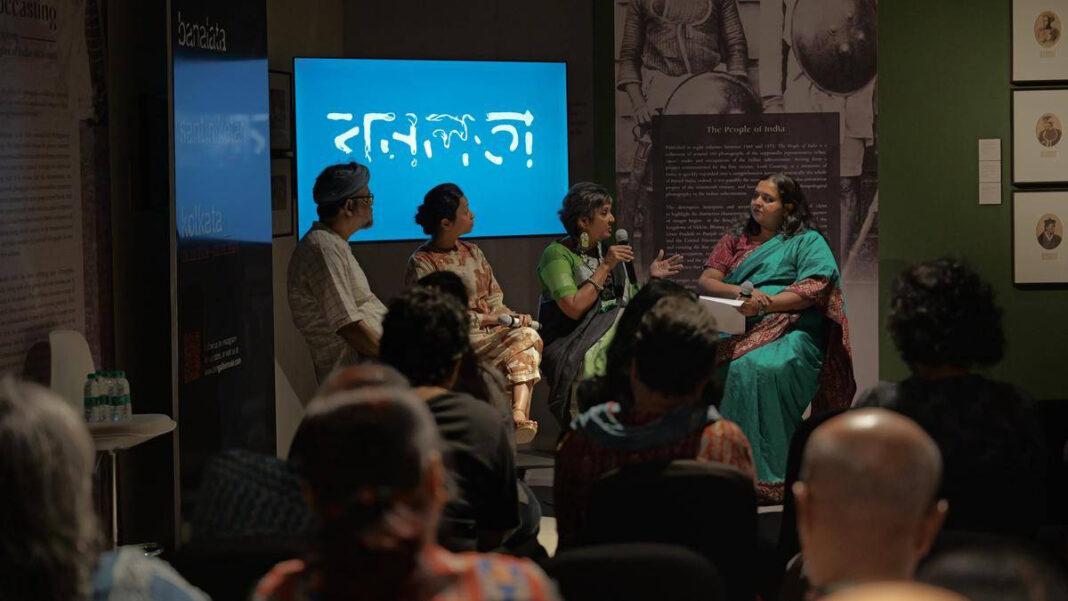
At the curtain-raiser on October 28 at Kolkata’s Alipore Museum, a panel discussion moderated by Sumona Chakravarty deputy director, DAG museums brought together Paula Sengupta, head, Department of Graphics-Printmaking and dean, Faculty of Visual Arts, Rabindra Bharati University; Devina Swarup, director, Paharpur Group; and Bhabatosh Sutar, co-curator of the Biennale and part of the artist collective Chander Haat. Their conversation explored the possibilities of taking art beyond conventional gallery spaces, the responsibility of preserving Bengal’s artistic histories, and the role of a biennale in opening up new encounters between artists and audiences.
A panel discussion moderated by Sumona Chakravarty Deputy Director, DAG museums brought together Dr Paula Sengupta, Head of the Department of Graphics-Printmaking and Dean of the Faculty of Visual Arts, Rabindra Bharati University, Devina Swarup director of the Paharpur Group and Bhabatosh Sutar, co-curator of the biennale and part of the artist collective Chander Haat
| Photo Credit:
Special Arrangement
For Paula, who participated in the previous and the first edition called Anka-Banka: Through Cross-Currents in 2024-2025 , that encounter was particularly significant. Her work, previously exhibited in fragments, was brought together as a complete body of work on a politically sensitive subject: the loss of home and forced migration. She wanted it to reach audiences beyond the familiar confines of galleries and museums.
“I also decided that I did not want to exhibit it in a gallery, but in a public space,” she said, explaining that the subject and the number of people it concerned made it important to reach as wide an audience as possible. The biennale, she felt, offered the right platform.
The exhibit coincided with a film festival, which helped draw large numbers of visitors at times, as many as 1,500 a day.
Paula also underlined how a biennale can free artists from some of the expectations attached to commercial exhibition spaces. “When you move into a non-commercial, not-for-profit space that is not necessarily connected to the market, it can liberate an artist,” she said.
Banalata , the second editon of the Bengal Biennale
| Photo Credit:
Bengal Biennale
The second edition seeks to extend these possibilities through Banalata, a framework that brings ecology and poetry into conversation with the subterranean histories of Bengal. Co-curator Ritika Biswas describes the project as an exploration of the often unseen networks through which people find kinship, refuge and ways to resist. The biennale turns towards grief, war and persistent loss, but also towards the possibilities of joy, solidarity and alternative forms of exchange.
“I envision the second Bengal Biennale as a slightly strange, slightly dissonant, slightly dark ecology which embraces the full spectrum of being alive in and to a burning world,” Ritika has said. She adds, “Banalata foregrounds emotion, rest, and poetics, as modes through which we might critically examine the systems and selves within which we are entangled. It endeavours to create new knottings of kinship and solidarity across Bengal and beyond. This Biennale attempts to hold poetics and politics as inherently and generatively entwined forces.”
Ritika Biswas, co-curator of the Biennale
| Photo Credit:
KARIM
More than 40 projects in this edition are new works conceived for the Biennale; others are site-responsive iterations of existing works or loans from collections. The programme brings together established Indian and international contemporary artists with practitioners who may never have had a solo exhibition or worked with a gallery. Rather than arrange artists within a hierarchy, the curatorial vision asks how their practices might inform and alter one another.
For Bhabatosh Sutar, the project also offers a way to draw attention to Bengal’s distinctive artistic trajectory — its histories, political concerns and generations of practitioners — while bringing those conversations into contact with the wider art world. The biennale’s ambition is not simply to showcase art but to create relationships between artists, institutions and audiences, and to make visible the cultural histories that have shaped the region.
Art, access and Bengal’s cultural legacy
That responsibility extends to the institutions supporting the event. Devina said the decision to support the biennale was deliberate. She argued that a city’s well-being cannot be measured by its physical infrastructure alone. “But what about the mind and the soul?” she asked. Devina also emphasised the importance of public art in making artistic encounters accessible beyond exclusive spaces, giving people across social and economic backgrounds the opportunity to respond to what they see.
Sumona sees DAG’s engagement with the biennale as part of a wider responsibility towards the artistic histories from which its collection has grown. She recalled DAG’s Ghare Baire exhibit which presented around 700 works from its collection across Kolkata and Chandernagore. The collection itself had been built through relationships with people in Bengal, including families who needed help preserving artists’ works.
DAG’s Ghare Baire exhibit at the Currency Building in Kolkata
| Photo Credit:
DAG
Perhaps this is where Banalata finds a deep resonance. A vine does not grow in a straight line; it reaches, coils, crosses and catches hold. Across Bengal’s old walls, public spaces and buried histories, the biennale follows a similar impulse — asking what can be recovered when art leaves its familiar enclosures, what stories emerge when people are invited to participate, and what forms of kinship might take root when memory is allowed to travel.
In a world marked by displacement, fracture and forgetting, the promise is not that art can undo history. It is that, for a moment, it can bring us closer to the lives history has scattered — and offer, amid the long wandering, the possibility of finding one another.