
“Thou still unravish’d bride of quietness, Thou foster-child of silence and slow time.” It is almost impossible not to recall John Keats’s Ode on a Grecian Urn as I enter Ashvita’s art collection, showcasing art from 19th and 20th-Century Madras. Here, time, with all its charm, is frozen in art that outlives the artists.
Starting with Tanjore paintings and kolu dolls arranged in one corner, the exhibition ends with a display of analog photographs from RK Studio. Each piece, a work of art, represents a fragment of time in history.
Layers of history are embedded in Tanjore paintings — a classical South Indian art form that evolved over centuries, with Thanjavur emerging as a thriving creative centre under Nayak rule and Telugu-speaking Raju community artists settling there to become its main creators. “Later, under Maratha rule, the style truly began to glow,” says Rithik Pramod, co-curator of the exhibition Between Tradition and Modernity, adding, “The Marathas blended their love of rich decoration with local traditions, bringing in the refined raised relief (gesso), glass beads, lavish gold foil and gemstones we recognise today.”
Simon Fonceca’s portrait of an officer of the Madras Light Cavalry Regiment
| Photo Credit:
Special arrangement
Despite their rich history, the art forms remain deeply personal. Most paintings depict deities such as a young Krishna and are created on wooden panels, with raised relief work and gold foil. These artworks hang in most Chennai households, where families worship them as their chosen deities.
Colour also acts as a hidden historical language in Tanjore paintings. The extensive use of gold leaf is not merely decorative. It also catches the flickering light of an oil lamp in a dimly lit puja room, lending the paintings a divine glow.
Rithik says the same about kolu dolls displayed in front of Tanjore paintings. “To a foreigner, a doll may be just a painted figure. To a family, it may be a grandmother’s gift, standing on the same step every Navratri. So whether a family is protecting a centuries-old Tanjore painting or passing down a traditional kolu doll, they are not just saving an antique. They are keeping faith, regional history and family identity alive in their own living rooms.”
Further along, the exhibition explores Chennai’s colonial past through portraits by European artists. These mostly include hand sketches of Madras and portrait paintings by George Chinnery and John Joseph Fonceca. “The official written records of Madras are full of administrative ledgers and Government decrees. They tell us about the business of the Empire, but very little about what the city actually looked and felt like. Art fills that gap,” Rithik says.
Among the European artworks, the portrait of Helana Oakeley particularly stands out. “The painting depicts Helana Oakeley, her family and their domestic staff in their home, surrounded by lush, jungle-like gardens, offering a peek into their life. Their paintings make me feel that documenting Madras through European perspective was important to them,” says Sruthi Srinivasan, co-curator of the exhibition.
The Portraits of Charles, Helena and Henrietta Oakeley in Madras
| Photo Credit:
Special arrangement
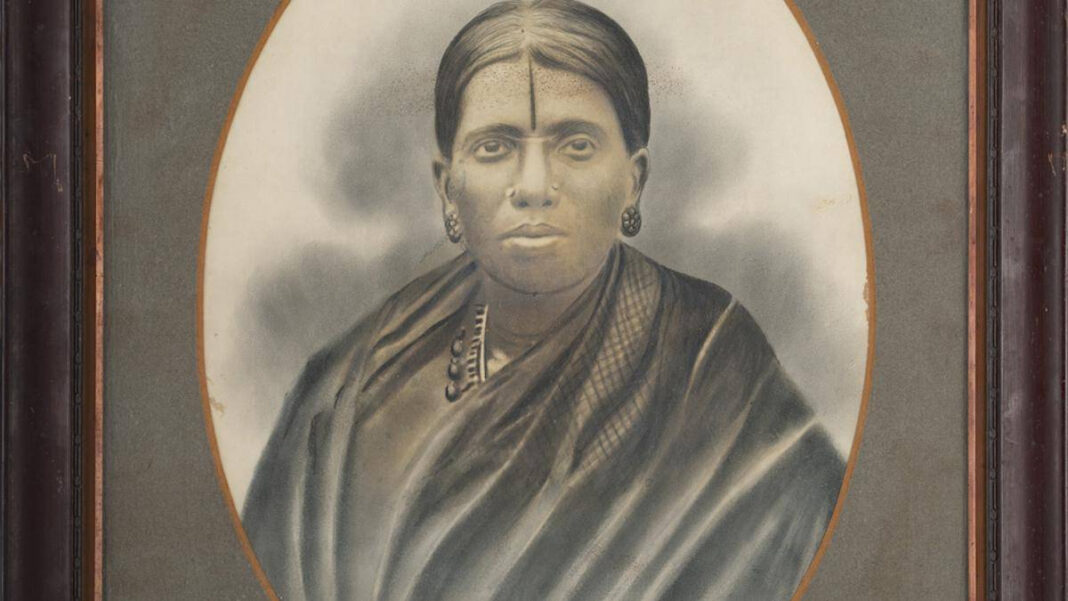
Nearby, oil portraits by Indian artists,Bhavani Charan Law, M Pachappa hang on the walls, capturing members of privileged communities who could afford to commission such works, which serve as documentation of their community, preserving its image for future generations.
Portraiture evolved further with the advent of photography. Subjects no longer had to sit for hours to have their portraits painted. Instead, photographs could be taken, enlarged, retouched with colour, and framed.
Analogue photographs from the 1980s also had a place in the exhibition on tradition and modernity. Drawn from the archives of Malavika Sarukkai and the KR Nathan studio, Royapettah High Road , they offer a glimpse into the evolution of photography in Chennai. “Photography is also an art; with the right lighting, right angle, the picture captures and documents the subject,” says Rithik.
“When we preserve these artworks, we are holding onto a blend of everything people have held dear across generations: deep faith, master craftsmanship, artistic knowledge, family traditions, and the legacy of the patrons who kept the art alive,” he adds.
The exhibition is open from Monday to Friday, 10am to 6pm, at Ashvita’s till November 22.
Published – October 15, 2026 08:30 am IST