
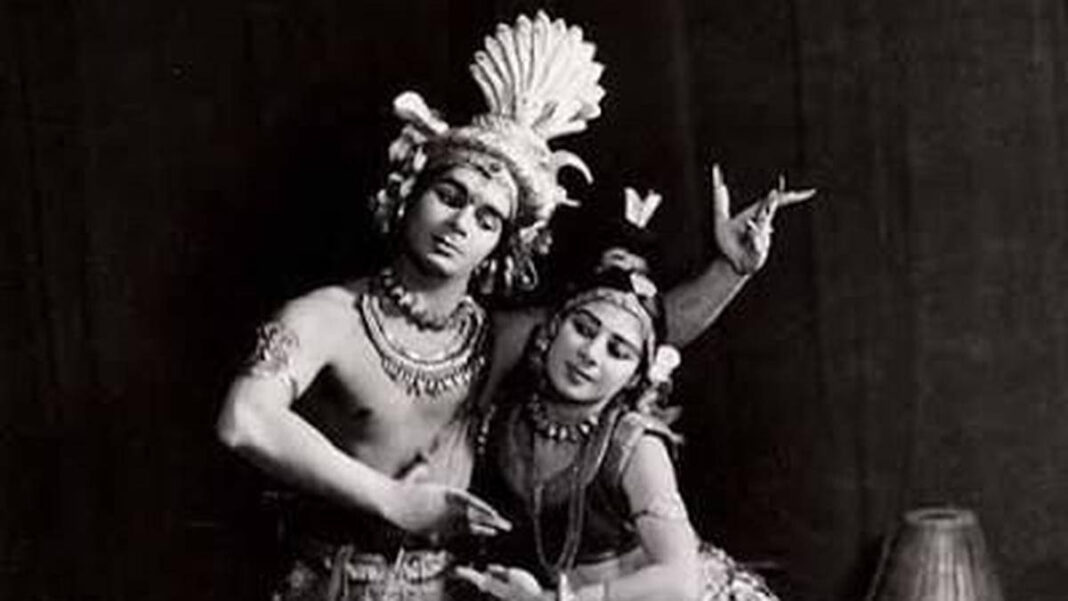

Dance has always been among India’s most visible art forms. Yet for all its richness, much of its history remains poorly documented. Performances disappear once the curtain falls, and generations of work survive through memory, oral histories and scattered photographs rather than a sustained visual archive.
The West, meanwhile, has a longer history of documenting ballet and modern dance through films. But filming dance is not simply about recording what happens on stage. The moment movement enters the frame, the camera, editing, sound and perspective begin to reshape it. The camera neither merely preserves dance nor is a passive observer; it changes the way dance can be seen, remembered and understood.
Ancestral Shadows was about dancing with the ghosts of the past.
| Photo Credit:
Special Arrangement
This was the premise behind the LURU Screendance Festival, launched by Bengaluru-based dancer-choreographer and dance film director Vishwakiran Nambi. The pilot edition, presented by the Vishwakiran Nambi Dance Company in collaboration with Choreoscope Barcelona Dance Films Festival, brought together dance films from India and across the world.
For Vishwakiran, the festival was a response to what he saw as a fundamental weakness in India’s relationship with its own dance history. “India is predominantly known for bad documentation,” he said. However, Uday Shankar’s Kalpana, made in 1948, is an exception. It was conceived not simply as a record of dance but as a work in which movement, cinema, music, design and narrative could exist together. Decades later, the film was restored through Martin Scorsese’s World Cinema Project. It is this history — and the gap between what India once attempted and what it has failed to sustain — that gives LURU its larger relevance.
The festival received 108 submissions from 30 countries, with 13 short dance films screened at Suchitra Film Society. The films varied widely in their understanding of movement and in the relationship they established between the dancer and the camera.
The Flight of the Shawl, directed by Jaime Dezcallar and featuring flamenco dancer Manuel Linan, was visually striking. Dezcallar’s Spanish Chica won the LURU Best Music Video Award, while Lino Eckenstein’s The Dust of My Concrete Child – Portrait 6: Risk & Balance won the Best Cinematography Award and his The Dust of My Concrete Child – Portrait 2: Viscousness & Vulnerability received the Best Choreography Award. India’s Sumedha Bhattacharyya’s film, Monalisa and Canada’s In My Room, by Kaitlyn Seibold, won the Best Screendance Film awards.
But does a cinematographer need to understand dance to film it effectively? Dezcallar challenged that assumption. Coming from the world of advertising rather than dance, he said his approach was driven by his passion for movement rather than formal dance training.
“I see the choreography and decide where the most interesting angle is. Sometimes I let dancers leave the frame, and sometimes I move with them. It depends on the feeling I want to express,” he said. That difference in approach points to one of Screendance’s central questions: should the camera understand dance from within, or can an outsider’s eye reveal something the dancer and choreographer may not see?
Dance films are a very specific kind of filming that has a tremendous potential, says Surupa Sen
| Photo Credit:
S.R. Raghunathan
Dancer, choreographer and scholar Uttara Asha Coorlawala, who has written extensively on Indian dance and its histories, feels one doesn’t have to understand dance, they just have to feel it.
For LURU’s debut edition, Vishwakiran deliberately kept the theme open-ended. The festival accepted films dealing with dance, music and movement, while future editions, he said, would focus more specifically on dance films and introduce themes.
Social media has trivialised dance into catchy loops and background noise, turning movement into memes. At the same time, it has introduced audiences to global work they might never otherwise encounter. Screendance sits at this crossroads — between democratisation and dilution, said Nambi, who has also directed the dance film The Kitchen and choreographed for Telugu, Kannada and Tamil films.
“Dance films are a very specific kind of filming that has a tremendous potential,” said Surupa Sen, artistic director of Nrityagram. During the pandemic, she found that filming could bring attention to details that were almost impossible to see in a live performance. “A kathak improvisation or an Odissi solo can be streamed, studied and revisited by audiences far beyond the space in which it was originally performed,” shared Surupa, who was asked by the New York Public Library to document her work. “It will then be available for people to access so they can understand how each choreographer works and thinks.”
Uttara also spoke about the freedom that the screen offers. “Screen dance also opens up a personal space, where what one sees is what one presents and what one feels is what one wants everyone to feel. There is no hesitation about clipping and cutting. Kalpana itself went through three rounds of editing, and each version changed the narrative. That shows how editing can reshape meaning,” she said.
In my room explored memories, grief and spaces.
| Photo Credit:
Special Arrangement
Going back to Kalpana, the making of which also reveals the longstanding struggle of artistes with patronage and resources.
Urmimala Sarkar Munsi, a social anthropologist, dance scholar, dancer and choreographer who has extensively researched Uday Shankar and his work, said: “The film starts with the dancer trying to sell his story to a producer who asks for something for the box office. Seventy years later, it’s the same story. Fantastic ideas dilute into something ordinary because there is no investor. What began as an act of creation also became an act of documentation. The film did not succeed at the box office, but remains seminal.”
For Nambi, this is the very reason why Kalpana remains such an important reference point and described screen dance as “a triadic conversation among camera, dance and space. Kalpana still stands the test of time — its factory choreography remains fresh, abstract and modern even today. You can cut and paste that into 2026 and it’ll still work.”
In India, he pointed out, no comparable attempt has followed. “I’ve pitched contemporary dance features to producers, but they back out. They think it’s too artistic, not for the common man. Even Balasaraswati needed Satyajit Ray to document her work.”
Surupa feels documentation also requires institutional commitment. “On a national level, the amount of investment that must be made, not just for the present but for the future, is hugely lacking,” she said. Yet, Surupa remains hopeful about what documentation can achieve.
The problem, then, is not merely the absence of films. It is the absence of a sustained archival culture around dance — one that records not just performances, but the thinking, process and vocabulary behind them.
LURU, therefore, is evolving as a space where boundaries among dance, cinema and documentation continue to blur.