
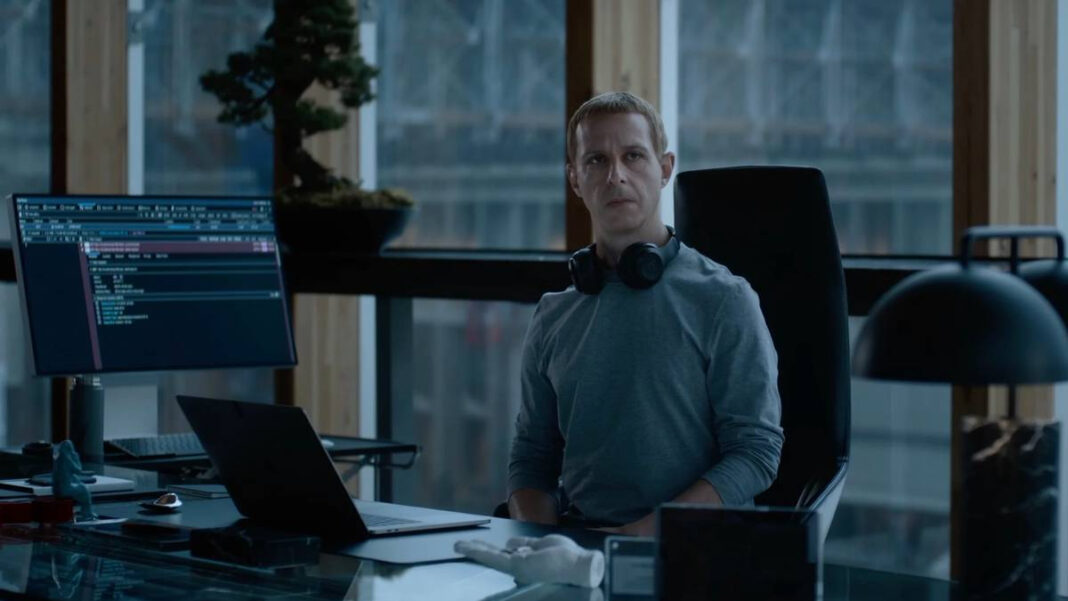

Tech CEOs are among the most terrifying products of 21st-century civilisation, largely because we have somehow convinced ourselves willingly or otherwise, to vest unprecedented political and cultural power in a bunch of sniveling men whose only qualification for exercising it is the pathological inability to imagine a world in which they are not the most important person in the room. Naturally, October has become 2026’s month to literalise the horrors of Silicon Valley, with Luca Guadagnino’s Sam Altman sketch Artificial, Alex Gibney’s Elon Musk documentary Musk, Nathan Fielder and Lance Oppenheim’s Elizabeth Holmes project You Can See Everything, and Aaron Sorkin’s The Social Reckoning lining up to anatomise this peculiar species of megalomania. Of the four, Indian audiences have only been subjected to Sorkin’s contribution so far.
Returning to the Facebook empire he helped immortalise in David Fincher’s impeccable The Social Network, the screenwriter turned writer-director has inherited a sequel nobody asked for after failing to secure either Fincher in the director’s chair or Jesse Eisenberg back as the Harvard sociopath who built a multi-billion dollar corporation out of his social inadequacies. Unfortunately, Sorkin’s directorial instincts remain so woefully underdeveloped that even the sharpness of his own dialogue seems to lose its lustre the moment he puts it in front of a camera.
The Social Reckoning (English)
Director: Aaron Sorkin
Cast: Mikey Madison, Jeremy Allen White, Jeremy Strong, Bill Burr, Betty Gilpin, Billy Magnussen
Runtime: 112 minutes
Storyline: Facebook engineer Frances Haugen and The Wall Street Journal reporter Jeff Horwitz blow the whistle on the social network’s most guarded secrets
Released in 2010, The Social Network was one of the decade’s most conspicuous Best Picture casualties, losing the Academy Award to The King’s Speech despite its fantastic screenplay and Fincher’s immaculate formal style. Sixteen years later, Sorkin is drawn back to the company’s sins through the Facebook Files — the Wall Street Journal’s 2021 investigative series, which drew on internal documents to expose how Facebook’s own research identified the harms associated with its products, while the company struggled to address problems involving misinformation, political polarisation and the recommendation algorithms that funnelled users towards increasingly extremist content.
Mikey Madison plays Frances Haugen, the former Facebook product manager who leaks internal material to investigative reporter Jeff Horwitz (Jeremy Allen White), while Mark Zuckerberg (Jeremy Strong) prepares for congressional scrutiny with the assistance of crisis manager Raya (Wunmi Mosaku) and argues over content moderation with former associate Charlie Garrigan (Bill Burr). Divided into three acts tracing the discovery of Facebook’s internal failures, the investigation that brings them to light, and the political fallout culminating in the January 6 United States Capitol attack in 2021, the film has no shortage of consequential material, but it seems to labour under the delusion that stringing together a series of incriminating revelations and theatrics automatically amounts to compelling cinema.
A still from ‘The Social Reckoning’
| Photo Credit:
Sony Pictures
Sorkin’s problem is that he has become so enamoured of his own intellectual and moral authority that his writing has become an elaborate exercise in self-congratulation, with every exchange engineered to ensure that his audience understands not only what he thinks, but how very pleased he is with himself for thinking it. For the man responsible for A Few Good Men, Moneyball, Steve Jobs and most crucially, The Social Network, his gift for tête-à-tête dialogue has dulled its edge. This fourth directorial feature since Molly’s Game, following The Trial of the Chicago 7 and Being the Ricardos, is a particularly dispiriting demonstration of how thoroughly his directorial ineptitude has repeatedly sabotaged his once-formidable screenwriting talents.
With The Social Reckoning, Sorkin is attempting to make sense of a world that has outgrown his understanding of it by returning to a scandal that broke five years ago, and while the Facebook Files remain an damning record of corporate negligence, it almost feels like he has only now discovered that the internet has gone to the dogs. This is nothing but sanctimony masquerading as political engagement, as though exposing Facebook’s crimes and performing the requisite outrage over them were sufficient enough to stave off the collapse of democracy as we know it.
I think Mikey Madison is a brilliant actress who keeps finding herself underserved by filmmakers who seem to have lost the plot, and having just come off Anora, it is frustrating to see her Oscar-winning talents funnelled into yet another film that feels beneath both her and the filmmaker responsible for it. Sorkin’s screenplay flattens Madison’s Haugen and Jeremy Allen White’s Horwitz into snarky, screenwriterly approximations of the two very real people whose painstaking investigation and considerable personal risks produced some of the most consequential investigative reporting of the century. Worse, the Sorkinisation of the espionage apparently required dressing Madison in a succession of flashy cocktail dresses so that hotel onlookers will mistake her clandestine meetings with Jeff for dates — an embarrassingly asinine creative liberty that just turns her professional risks as a whistleblower into an entirely avoidable excuse for some deeply juvenile titillation.
The man of the hour is inevitably Jeremy Strong, who after delivering a delectably contemptuous portrait of Donald Trump’s legal fixer Roy Cohn in Ali Abbasi’s The Apprentice, arrives here with what could have been a career-defining opportunity to inhabit another architect of American rot. Logan Roy’s eldest boy finally gets to sit atop a tech oligarchy of his own, except that Strong’s notoriously method interpretation of Zuckerberg is so painstakingly mannered that it has turned into one of the most contrived performances of his career. This is Sorkin’s boomer-brained interpretation of the internet’s lizard-person shitposting, filtered through years of second-hand Zuckerberg lore and regurgitated by Strong desperately trying to personify a human attempting to pass a Turing test. There is certainly something recognisably inhuman about Zuckerberg’s public persona, with that Elizabeth Holmes-esque thousand-yard stare, but this interpretation entirely sands away and caricatures what truly makes Zuckerberg one of the most soulless individuals ever to be afforded the moniker of humanity (that Jesse Eisenberg made so indelible 15 years ago), reducing his corporate amorality to a cartoonish absence of human feeling.
A still from ‘The Social Reckoning’
| Photo Credit:
Sony Pictures
But Eisenberg isn’t the only ghost of The Social Network still haunting this sequel, whose mere existence seems engineered to invite unfavourable comparisons. I would love to have watched The Social Reckoning without the original lodged in my memory, but the two are inextricably linked, and the disparity in filmmaking prowess is impossible to ignore. Even with Jeff Cronenweth returning behind the camera, clearly nobody moves the camera like Fincher does. The most conspicuous absence however, is Trent Reznor and Atticus Ross’s extraordinary Oscar-winning score, whose sinister electronic minimalism gave the original its unmistakable sense of creeping dread. I have something approaching a personal vendetta (read: seething bloodlust) against Alexandre Desplat for repeatedly edging out more deserving scores during awards seasons, but even setting that aside, his work here is an astonishingly bloodless collection of generic dramatic cues, so devoid of personality or invention that it barely passes as music, let alone as a score worthy of inheriting the inimitable legacy of its predecessor.
But the film’s most damning failure is how utterly spineless Sorkin’s brand of social-justice filmmaking has become. The first signs of his political tepidity were already creeping into The Trial of the Chicago 7, but The Social Reckoning makes a limp spectacle of his reluctance to name the political figures or institutions lurking behind its poorly sanitised allusions. His treatment of January 6 is even more revealing, with repeated recreations of the Capitol attack somehow making the whole affair feel nothing more than an extended exercise in police victimhood. That the racialised confrontation between a white woman and two POC police officers from the opening sequence reinforces this same tendency only makes the film’s political instincts look more suspect.
For a Hollywood-scaled exposé to ostensibly lay bare Meta’s role in the industrial-scale monetisation of public dysfunction and radicalisation, this is a spectacularly anaemic reckoning with the greed, negligence and political harm that Zuckerberg has perpetuated. Sorkin really, really wants to position himself alongside All the President’s Men and Spotlight, but all The Social Reckoning really accomplishes is exposing his lukewarm, neoliberal sensibilties, which is perhaps the worst possible combination when paired with his egregious limitations as a director.
The Social Reckoning is currently running in theatres
Published – October 09, 2026 05:23 pm IST