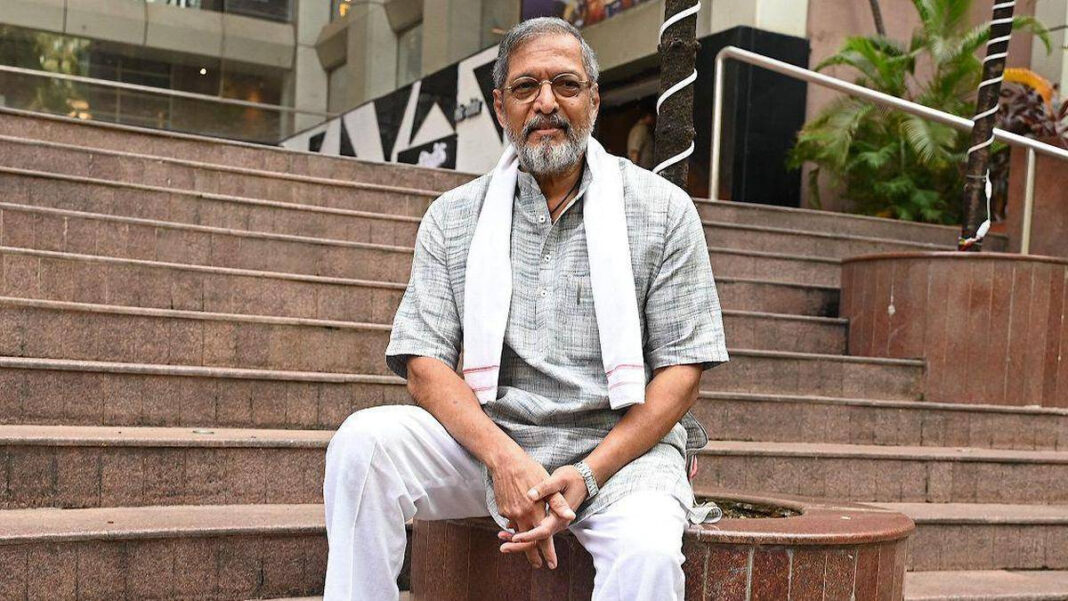

As a judge on Indian Idol a year ago, Nana Patekar sat immersed in music as contestant Sneha Shankar sang ‘Ye dil tum bin kahin lagta nahin’ (from the film Izzat), punctuating her rendition with appreciative “wah wahs”. When she finished, he stood up and asked if she knew the next antara, beginning with ‘Mohabbat kar to le lekin…’. As she sang, he stood listening, savouring every nuance. Many actors appear on reality shows as guest judges, often as part of film promotions. Nana’s presence, however, felt different. He brought an unfeigned love for music and an artiste’s curiosity to the proceedings. His engagement with the contestants was genuine, marked by the sincerity and spontaneity that characterised him wherever he went. It was also a glimpse of a lesser-known side of Nana Patekar.
Singer Subashree Debnath’s recalled a similarly memorable encounter on Sa Re Ga Ma show, when he requested her to sing ‘Jaane kya baat hai’, the timeless Lata Mangeshkar classic. “That beautiful interaction, his warmth, presence and love for music created a memory I will carry forever,” she wrote in a Facebook post. On yet another music reality show, the actor surprised contestants by taking his place at the tabla and inviting a singer to perform alongside him.
These moments revealed an artiste who cherished the interconnectedness of the arts. At a time when artistic practices often operate in silos, Nana Patekar recognised how one form enriched another. That understanding, perhaps, is what set him apart as an artiste.
The world celebrated Nana Patekar for his exceptional acting on screen and stage, but he was equally a passionate rasik of Indian classical and folk music. Just three days before his passing, he was seen playing the ghumot, Goa’s traditional percussion instrument, at a cultural event in Panaji, a poignant reminder of a lifelong engagement with the arts.
Nana Patekar playing the ghumot at an event in Goa
| Photo Credit:
Special Arrangement
I witnessed this firsthand at a concert by senior Hindustani vocalist Kalapini Komkali at Mumbai’s National Centre for the Performing Arts. An ardent admirer of her father, Pt Kumar Gandharva, Nana sat through the concert in rapt attention. Before leaving, he spoke to a few fellow attendees about the Kumar Gandharva compositions he especially cherished.
Says Shashi Vyas, Mumbai-based cultural curator and founder of the music organisation Pancham Nishad: “He was a regular at the Chintamani Jayanti Samaroh, which I organised in memory of my father, the renowned vocalist and composer Pt. C.R. Vyas. Whenever he was unable to attend, he would invariably call to say how much he would miss the event. What was remarkable was the breadth of his listening. He admired stalwarts such as Begum Akhtar, Bal Gandharva, Pt. Bhimsen Joshi and Kishori Amonkar, and also followed Carnatic music, fondly listening in recent years to musicians such as T.M. Krishna.”
Nana would often hold intimate baithaks at his Pune home and host some of his favourite musicians for lunch or dinner, among them was Ustad Rashid Khan. “These gatherings reflected not just his love for music but also his desire to be in the company of musicians, listen to them closely and learn from them. For Nana, music was not a pastime but an enduring passion that shaped many of his friendships and artistic associations,” says Shashi.
In interviews over the years, Nana Patekar has often spoken about how classical music helps calm him and shut out the chaos around him. Trained in commercial art at Mumbai’s Sir J.J. School of Art, he strongly believed that creative minds could heal a fractured world.
“Two months ago, he called me from the gym and said, ‘I am listening to your raag Bagesri. Kya bajaya hai!‘ (How beautifully you have played). He would listen to classical music or ghazals while exercising. Before ending the call, he advised me to stay true to my legacy and not get carried away by gimmicks,” recalls sitarist Shakir Khan, son of sitar maestro Ustad Shahid Parvez and one of the young musicians to watch out for.
“He loved abba’s (Ustad Shahid Parvez) playing a great deal and rarely missed his performances. They shared a relationship built on mutual admiration and affection. So I have known him since my training days. You cannot imagine what a serious listener he was. Once, he came to a sitar workshop that I conduct every three months in Pune and sat through the entire three-hour session. He first watched me guide the participants and then asked me to play raag Pilu. He listened quietly, absorbing every note,” shares Shakir.
Nana’s bond with Indian classical music is said to have begun when he first heard the inimitable Gangubai Hangal and became her ardent admirer. He thereafter made it a point to attend her concerts in Mumbai and Pune, becoming a familiar presence at the Sawai Gandharva Sangeet Mahotsav, to listen to her and other greats of Hindustani music.
The iconic Marathi musical Katyar Kaljat Ghusli, which tells the story of a rivalry between two musical gharanas, is also said to have kindled Nana Patekar’s interest in Natyasangeet, Maharashtra’s rich tradition of musical theatre. The production starred the legendary vocalist Pt Vasantrao Deshpande and continues to be celebrated for its timeless songs. Years later, when Pt Deshpande’s grandson, singer Rahul Deshpande, revived the play, Nana became one of its strongest supporters. He went on to serve as a patron and trustee of the Dr Vasantrao Deshpande Pratishthan and helped organise Vasantotsav, Pune’s annual three-day classical music festival.
Not just an avid listener of music, Nana Patekar also had a way with words. He wrote poems that reflected on life’s realities and was often heard reciting them in his characteristic baritone at public events. The Marathi album Nanachhand, released in 2024, featured verses penned by him.
When the auditorium darkened and the camera stopped rolling, actor Nana Patekar returned to a life beyond the arc lights, one enriched by music and poetry. He turned his home into a space where art found its simplest yet most profound expression.
Published – October 09, 2026 11:01 pm IST