 "
/>
"
/>

175 Years of History: The Enduring Legacy of Chennai’s Government College of Fine Arts
On a bright October morning, the beauty of Chennai’s Government College of Fine Arts, Egmore, is not solely defined by its iconic red facade but by the sculptures that adorn its expansive campus. These captivating sculptures, often resembling human figures, have stood the test of time, echoing the stories of countless students who have walked its halls and transformed the global art landscape. As the college celebrated its 175th anniversary on October 3, it provided an opportunity to reflect on the rich history, memories, and lasting impact that this historic institution has imparted over the years.
Painting the Past
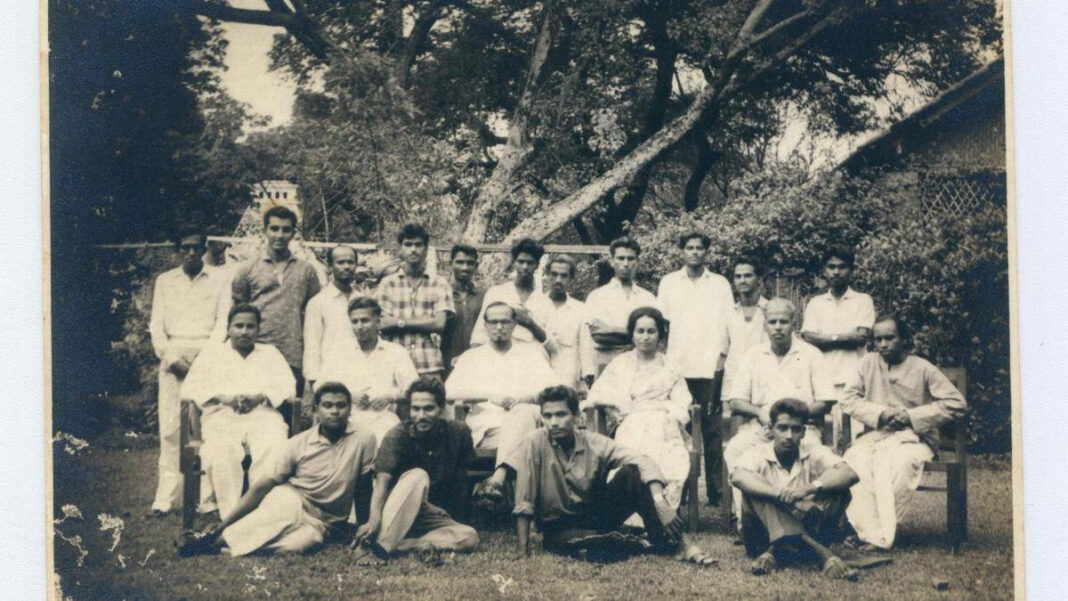
Established in 1850, the Madras School of Arts, as it was originally known, spent its initial 80 years primarily focusing on industrial crafts. The direction of the institution began to shift in 1884 when E. B. Havell was appointed as the superintendent. The curriculum was tailored around workshops that emphasized craft, but by the late 1920s, an evident gap emerged—a lack of fine artists produced by the school. This pivotal moment led to a significant change in 1929 when Bengali sculptor Devi Prasad Roy Choudhury became the first artist-principal of the school, introducing a formal curriculum that emphasized both painting and sculpture.
Under Roy Choudhury’s leadership, the educational philosophy underwent a transformation. He streamlined the program, which previously allowed many students—often the sons of artisans who received stipends—to remain enrolled for up to 10 years without graduating. His reforms resulted in the school’s first cohort of fine artists in 1935. “When Roy Choudhury took over as the first Indian principal, he integrated the academic curriculum crafted by notable artists like Nandalal Bose and Abanindranath Tagore,” notes Ashvin E. Rajagopalan, director of Ashvitas gallery in Chennai, which showcases the work of alumni and participants of the Madras Arts Movement.
One of the college’s alumni, G. Raman, from the 1959 batch, fondly remembers the impact Roy Choudhury had on his education. “He was a teacher we all looked up to. He would never simply pass by a student; he would stop, examine their work, and sometimes even draw something to demonstrate,” recalls Raman.
Many Masters
In the years following Roy Choudhury’s reforms, the educational methods evolved. “He removed the outdated anatomical models, replacing them with live models, which greatly transformed the learning environment,” says art historian Ashrafi S. Bhagat. The college saw the enrollment of notable students like K. C. S. Paniker and S. Dhanapal, who graduated in 1940. Both were later appointed as teachers by Roy Choudhury, with Paniker eventually ascending to the role of Principal in 1957 after Roy Choudhury’s retirement.
Paniker played a crucial role not just in education but as a pioneer of the modernist Madras Art Movement that emerged in Chennai in the 1960s. “When I was in college, Paniker emphasized that students should learn a critical grammar of expression rather than merely emulate a master,” says artist P. Gopinath, a member of the Cholamandel Artists Village. “His approach allowed many students to exhibit their work on prestigious international platforms, promoting a unique collaborative spirit within the college.”
Paniker’s pedagogical approach introduced students to a wide array of modern European art movements. “He discussed works by Impressionists, Post-Impressionists, Cubists, and Abstract Expressionists, opening up a world of artistic inspiration for us,” remarks Bhagat. This era was enriched not just by Paniker but also by other faculty members who actively facilitated exhibitions for Madras artists across India.
From Magazine to Classroom
During the late 20th century, the college witnessed an exciting period of artistic exploration. Maruthappan Marudu, better known as Trotsky Marudu, who graduated in 1977, describes the 1970s as a golden age for art in Tamil Nadu. “I first learned about this college through an article in Ananda Vikatan, and from that moment, I aspired to study there,” he recalls. His experiences included engaging theatre workshops and film screenings that ignited his passion for art and animation.
In a college environment primarily dominated by male students, artist Asma Menon shared her unique experience as one of the first women in her degree program. “The freedom to express ourselves artistically was empowering, allowing us to take breaks and sketch in the garden,” she recounts, reflecting on her time spent in the company of male classmates.
The College Library
For New York-based artist Ebenezer Sunder Singh, who graduated in 1989, the college library was a pivotal resource. “My first exposure to influential artists like Wassily Kandinsky came from books I found there,” he explains. Singh recalls how his art history teacher, Leela Ganapathy, nurtured his learning by encouraging him to share his insights with classmates, a practice that fostered an enriching learning community.
Over the years, the college underwent several name changes—from the Madras School of Arts and Crafts to the Government School of Arts and Crafts and finally, in 2001, to the Government College of Fine Arts. Each name reflects the institution’s role in shaping various art movements across the city, according to Ashvin.
The Way Forward
Entering the 1990s, the landscape of art began to evolve significantly. Artist Aparajithan Adimoolam describes this period as transitional. He reflects, “With a legacy dating back to the 1850s, I was required to respond to a longstanding narrative ingrained in our education and dialogues.”
By the early 2000s, the college expanded its offerings, introducing new courses, including the Master of Fine Arts (MFA) program, which welcomed older students and fostered a diverse learning environment. Ezhilarasan Ezhumale, who graduated in 2005, appreciated the participatory nature of the classroom. “Professors were deeply involved in various disciplines, which allowed us to engage with real-world art history,” he says, recounting field trips to explore ancient rock art sites.
As the college approaches its 176th year, it stands steadfast, a testament to artistic evolution and enduring legacy. The red-brick structure of the Government College of Fine Arts continues to symbolize a vibrant artistic community that nurtures creativity and innovation, honoring the artistic journeys of generations past while inspiring future artists.