
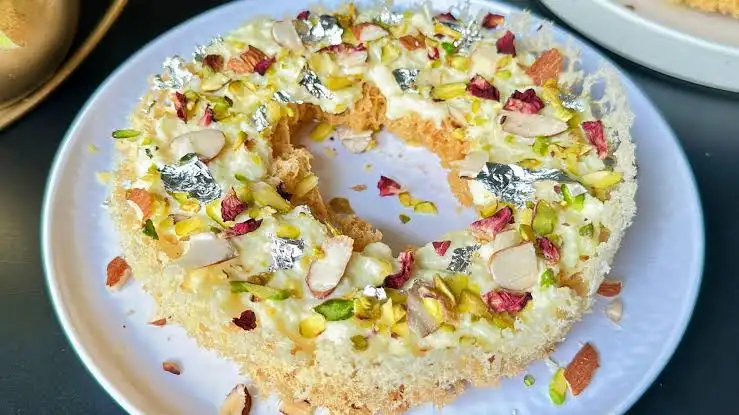

The history of ghevar traces the transformation of an intricate culinary craft into one of India’s most iconic traditional delicacies. Distinctive for its disc-like shape, porous honeycomb texture, and delicate sweetness, ghevar holds a prominent position in Indian confectionery culture. While today it is enjoyed across North India, understanding the history of ghevar reveals deep roots embedded in the desert climate, royal kitchens, and festive calendar of Rajasthan
The Royal Origins: Where Did Ghevar Come From?
Tracing the precise timeline in the history of ghevar leads to the royal courts of Rajasthan, where halwais (traditional sweet makers) experimented with temperature, technique, and ingredients
Monsoon Chemistry: Rajasthan’s arid environment made frying delicate sweets challenging. Sweetsmiths discovered that the humid monsoon air provided the necessary moisture balance to keep fried flour batters light and aerated.Royal Patronage: Maharajas and noble courtiers savored ghevar as a luxury treat during festive victories and royal celebrations.
Alternative Theories: Some culinary historians suggest early origins near Uttar Pradesh or Middle Eastern influences during Mughal rule, but the cultural ownership and perfection of the dish unquestionably belong to Rajasthan
The defining chapter in the history of ghevar lies in its unique preparation technique. Unlike standard Indian sweets prepared from solid doughs or condensed milk, ghevar requires precise thermodynamic balance:Chilled Batter: Refined flour (maida) is whisked with solidified ghee and ice-cold water or milk to form a thin, smooth liquid batter.Thermal Shock: The cold batter is poured in a thin stream into a heavy mold containing piping hot ghee.Porous Web Creation: The drastic temperature contrast causes water vapor to expand rapidly, instantly forming a delicate, porous, lace-like disc.Sugar Syrup Soaking: The fried disc is removed, drained, and saturated in warm, cardamom-infused sugar syrup.
As the history of ghevar progressed through centuries, traditional halwais evolved the classic recipe into diverse modern variations:Plain / Sweet Ghevar: The classic honeycomb disc soaked purely in sugar syrup (Chashni).Malai / Rabdi Ghevar: Topped with thick, cardamom-scented condensed milk and garnishes of pistachio, almond, and edible silver leaf (varq).